
One of the most important insights I took away from my participation in the 5th World Small-Scale Fisheries Congress in Hua Hin, Thailand earlier this month, came through a concept that I had not previously thought much about: the Right to Food. This was, in many ways, the idea that most shifted my thinking. The Right to Food is not simply a broad aspiration related to food security. It is a human right, grounded in international human rights law, that protects the ability of people to feed themselves with dignity. It implies that sufficient food is available, that people have the means to access it, and that the food they consume is adequate, safe, nutritious, and culturally appropriate.
In the context of small-scale fisheries, this matters enormously. Small-scale fishers are not only providers of income and employment. In many parts of the world, they are also the backbone of local food systems. They provide fish and aquatic foods that are essential to nutrition, identity, culture, and everyday food access for coastal and inland communities. Yet despite this, the Right to Food often remains surprisingly absent from the way seafood sustainability is discussed in practice.
That absence struck me strongly. In current conversations around CSR, ESG, and human rights due diligence, including those increasingly shaped by regulatory developments such as the EU Corporate Sustainability Due Diligence Directive, attention often focuses on human rights risks that are easier to identify, frame, and audit. Those issues are important and deserve that attention. But the Right to Food is no less a human right than any other. It is simply less visible in the frameworks and conversations that many actors in seafood currently use.
How tenure rights and participation impact the Right to Food
This is where the Congress helped me connect the dots in a new way. My colleague, Miguel Andreu-Cazenave, was also at the Congress, presenting about two new indicators that SFP has developed within FishSource to assess fisheries performance in two areas related to small-scale fisheries: Security of Tenure Rights (STR) and Participatory Management (PM). Many of the same governance conditions that these new indicators assess are also highly relevant to understanding whether less visible rights, such as the Right to Food, may be at risk in a fishery system.
If fishers do not have secure and legitimate access to resources, if they are excluded from decisions about how fisheries are managed, if benefits are distributed inequitably, and if market dynamics are reshaping the flow of fish away from local food systems without meaningful local agency, then the conditions may exist for the Right to Food to be weakened, even where no one is explicitly measuring that risk.
That is what made secure tenure rights and participatory management suddenly feel even more important to me. I no longer see them only as governance indicators in a narrow sense. I see them as potentially useful baseline signals of broader social and human rights conditions in fisheries systems. They are not substitutes for a dedicated human rights assessment, and they cannot by themselves determine whether the Right to Food is being respected. But they may help identify fisheries where the structural conditions for rights-related harm are more likely to exist.
Put simply: when Security of Tenure Rights and Participatory Management scores are low, that should raise concern. It should suggest that rights which are often less visible in seafood systems, including the Right to Food, may deserve closer scrutiny.
Why this matters
This matters not only for researchers or NGOs, but also for companies and other actors carrying growing responsibilities under human rights due diligence frameworks. One of the most practical implications of this work is that a tool already used by sustainability teams may also help colleagues in human rights departments carry out an initial scan of baseline risk. That creates a potentially useful bridge between two functions that often remain too separate: sustainability and human rights.
The Right to Food is a particularly good example of why this bridge matters. Global sustainability frameworks such as the UN SDGs and the SSF Guidelines rightly emphasise the importance of improving market access for small-scale producers as a pathway to stronger livelihoods and greater resilience. In many contexts, that is exactly right. Better market access can improve incomes, strengthen bargaining power, reduce vulnerability, and support more sustainable fisheries management.
Understanding the trade-offs
But the Congress also made clear to me that there can be trade-offs that deserve closer attention. In some contexts, connecting small-scale producers to better-paying markets may also redirect fish away from local food systems, increase local prices, or reduce access to nutritious food for the communities that depend on it most. In those cases, a sustainability strategy that appears positive from one angle may look more complicated when viewed through the lens of the Right to Food.
This is not an argument against market access. It is an argument for better diagnosis. It means asking more complete questions: Who currently depends on this fish for food and nutrition? How might changes in value chains affect local availability and affordability? Are some groups — such as women, children, poorer households, migrant workers, or Indigenous Peoples — affected differently? Are fishers and communities meaningfully involved in decisions about how their resources are used and where their product goes?
Seen in that light, the Right to Food did not pull me away from thinking about FishSource. It actually helped me reimagine its potential. What began for me as a reflection on one human right ended up opening a broader question: could FishSource evolve from being seen mainly as a sustainability tool into a tool that also helps identify less visible human rights risks associated with fisheries?
I think the answer may be yes.
FishSource’s STR and PM indicators already point in that direction by helping make some foundational governance conditions more visible. Looking ahead, there may be scope for FishSource to develop additional indicators that provide a more structured baseline view of human rights risks that still receive too little attention in seafood supply chains. The value of that would be twofold: first, to help human rights teams identify risks that might otherwise remain off the radar; and second, to do so in a way that connects directly with the information already used by sustainability teams.
That kind of integration feels important. Too often, environmental sustainability, governance, and human rights are still assessed in separate silos, even though in reality they are deeply intertwined. A more holistic understanding of fisheries systems would help us better see how resource governance, social legitimacy, access rights, market structures, and community wellbeing all shape one another.
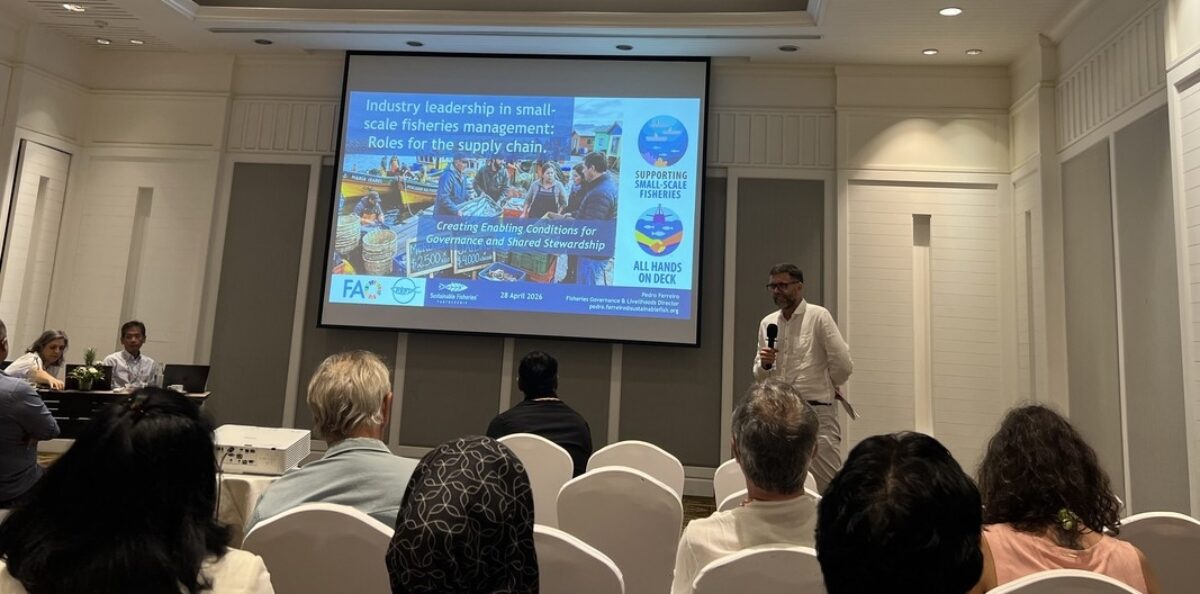
Pedro presenting at the Congress
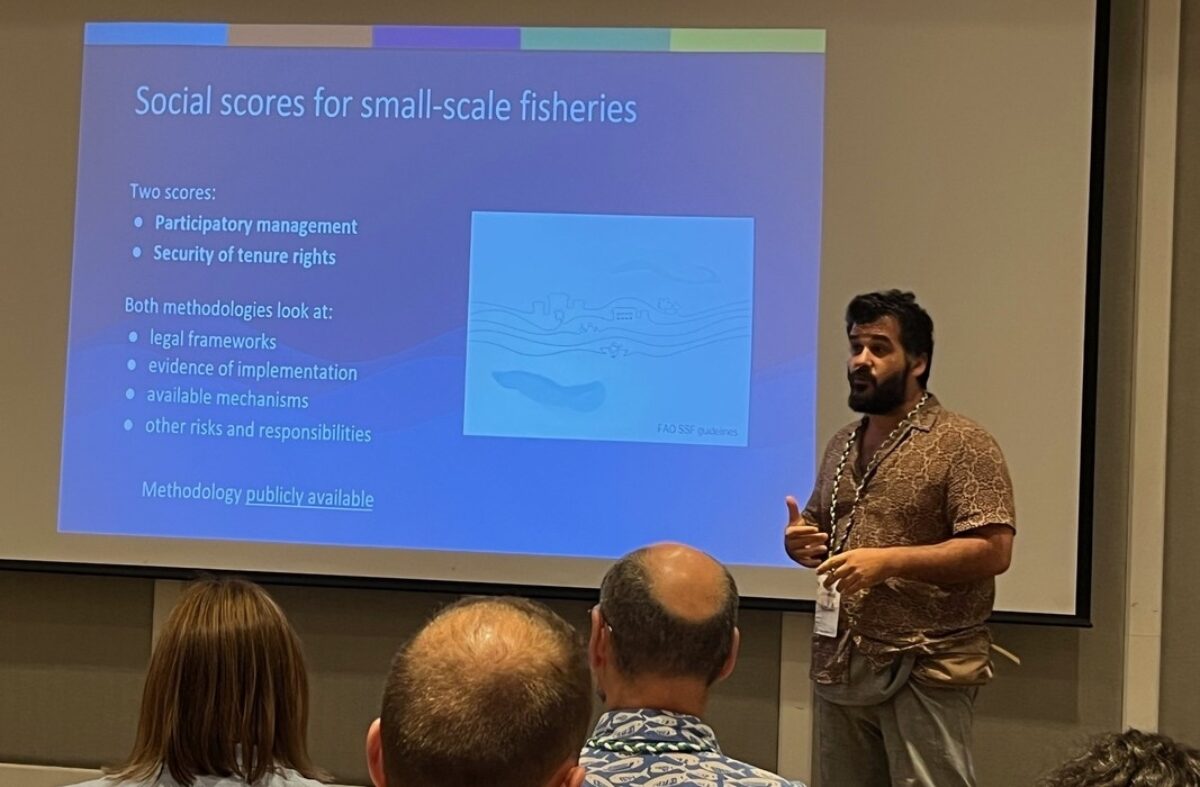
SFP’s Miguel Andreu-Cazenave presenting at the Congress on small-scale fisheries scoring in FishSource