This is part of a series of blogs from SFP staff about our collaborative efforts to improve fisheries management in the Gulf of Thailand through the GoTFish Project. The project brings together a regional, multi-stakeholder initiative, funded by the Global Environment Facility (GEF) and implemented by the Food and Agriculture Organization of the United Nations (FAO), in partnership with the Southeast Asian Fisheries Development Center (SEAFDEC), SFP, and the University of Queensland.
When we talk about improving fisheries, it is easy to focus on what happens at sea: fishing practices, species composition, management measures, and sustainability. But recently, I’ve been reminded that what happens after the fish are landed can be just as important.
In September, I participated in two days of meetings and visits in Thailand, as part of SFP’s work under the GoTFish multi-species trawl workstream. We met with fishmeal producers, industry associations, MarinTrust, FAO, and SEAFDEC. Each conversation offered a different perspective on the same question: How can we make responsible sourcing work in practice for a fishery with complex, mixed catches?
What was particularly valuable was that we were not discussing this question in a conference room. We were sitting with the people who actually process the fish.
Seeing the supply chain from the fishmeal industry’s perspective
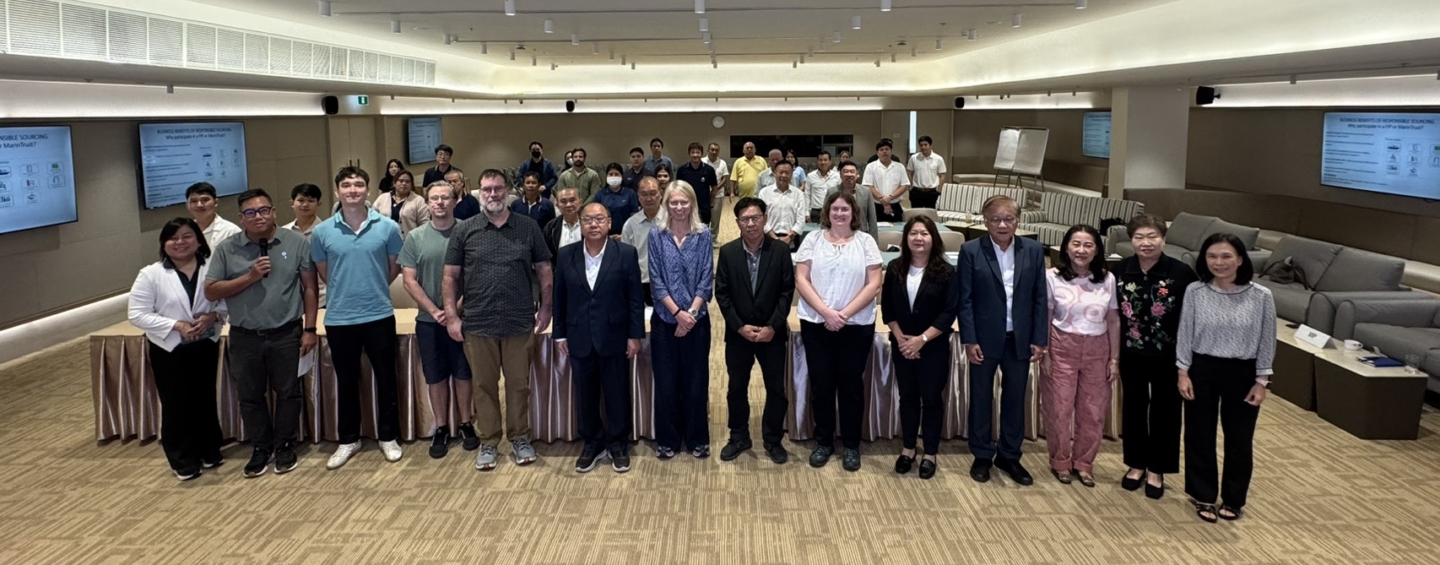
On the first day, we visited a fishmeal plant to discuss raw materials sourcing, production volumes, certified and non-certified fishmeal, and the MarinTrust Improver Programme and standard. Later in the day, we met with representatives of more than 15 fishmeal companies who are part of the Thai Fishmeal Producers Association, as well as representatives from other fisheries and seafood associations.
For me, this was an important opportunity to listen.
We often talk about traceability, species identification, and responsible sourcing as if the necessary information is straightforward to collect. But when we heard directly from fishmeal producers, the situation looked more complicated. The producers explained the challenge of identifying and recording species when raw materials come from mixed trawl catches. A single supply of raw material can contain a range of species, and identifying those species at the point of landing or purchase is not always fully within the fishmeal producer’s control.
The conversation helped me think differently about how we approach requirements for responsible sourcing: If we want industry to participate, those requirements have to reflect what can realistically be done on the ground.
This does not mean lowering expectations. Rather, it means understanding where information comes from, who has control over it, and what kind of system can provide reliable information without creating requirements that are impractical to implement.
Where fish can be sourced from
Another issue raised by producers was the geographical scope of sourcing. Some fishmeal companies who source raw material from the Andaman Sea during seasonal closures in the Gulf of Thailand raised the question of whether this material falls within the current MarinTrust/FIP sourcing area and whether the Andaman Sea could potentially be included.
On paper, this may look like a question about a boundary on a map. However, from the perspective of a producer, it is much more practical: Which fish can we actually use if we want to participate in a responsible sourcing initiative?
This was another reminder that responsible-sourcing systems need to consider how fisheries and supply chains operate in the real world. The immediate next step is to clarify both the species-recording requirements and the eligible sourcing area with MarinTrust and FIP partners.
Connecting the industry conversation with the bigger picture
The following day, we moved from the factory floor to a broader coordination discussion with FAO, SEAFDEC, and MarinTrust. The meeting brought together different perspectives around GoTFish implementation, responsible sourcing, FIPs, market incentives, certification, private-sector participation, and multispecies fisheries.
This was where the conversations from the previous day started to connect to the bigger picture.
The challenges raised by fishmeal producers are not isolated technical issues. They are related to how we design FIPs, how multispecies fisheries are assessed, how responsible sourcing is demonstrated, and ultimately how market mechanisms can support better fisheries practices.
One of the most interesting parts of the discussion was the potential alignment between GoTFish’s multispecies fisheries work and MarinTrust’s work on multispecies indicators. MarinTrust is preparing to review its current multispecies indicators, with the intention of eventually incorporating them into its standard, rather than keeping them within the current improver-programme pilot. They are also interested in leveraging GoTFish experiences and aligning their work with the FAO toolkit and ongoing multispecies work.
As someone working on the GoTFish multi-species workstream, I found this particularly encouraging. It suggests that the work we are doing through GoTFish does not have to remain within the boundaries of the project. The knowledge generated through the project could potentially contribute to broader discussions around standards, indicators, and responsible sourcing.
Why these conversations matter
One thing I took away from these meetings is that there is no single actor who can solve the challenges of multispecies fisheries alone.
Fishers are one part of the picture. Fishmeal producers are another. And certification initiatives, governments, regional organizations, buyers, and NGOs all bring their own perspectives and responsibilities.The value of these meetings was in putting these perspectives together. For SFP, this is particularly relevant because our role under GoTFish Component 2 is to explore how market and behavioral incentives can support better fisheries practices.
That means we need to understand the market actors we are trying to engage. We need to understand what information they have. We need to understand what information they do not have. And we need to understand what would make participation in a FIP or responsible-sourcing initiative practical and meaningful for them.
From Thailand to a regional conversation
These discussions were also a reminder that the multi-species trawl work cannot be viewed only through a Thailand lens. The GoTFish project has a regional dimension, and the coordination meeting also discussed Viet Nam’s engagement. The 2027 Responsible Seafood Summit in Ho Chi Minh City was identified as a potential opportunity to strengthen the case for Viet Nam’s participation in GoTFish and build on successful sessions held during this year’s summit.
For me, this reinforces why regional collaboration matters.The fisheries, supply chains and markets connected to the Gulf of Thailand do not always fit neatly within national boundaries. Learning from the experience of one country can help inform conversations in another.
What I am taking away
I came away from these meetings not only with a clearer understanding of the challenges we need to address, but also with a better appreciation of the questions we still need to answer and who needs to be part of those conversations: We still need to determine how species identification and recording should work for mixed-fish raw materials. We need to clarify the eligible sourcing area. And we need to continue exploring how GoTFish’s multispecies work can connect with MarinTrust, FAO, and other initiatives.
Responsible fisheries are built not only through technical methodologies or standards. They are built through conversations—sometimes with people we do not normally sit with—and by understanding the practical realities behind the supply chain.
Standing in a fishmeal plant and hearing producers explain the challenges of mixed catches gave me a perspective that is difficult to gain from a project document alone. And that is perhaps the biggest lesson I took from these two days:
If we want responsible sourcing systems to work, we need to design them in collaboration with the people who will actually use them.
For the GoTFish multi-species trawl workstream, the next step is to turn these conversations into practical solutions—solutions that can connect fisheries improvement, responsible sourcing and market incentives, while reflecting the realities of the people working throughout the supply chain.