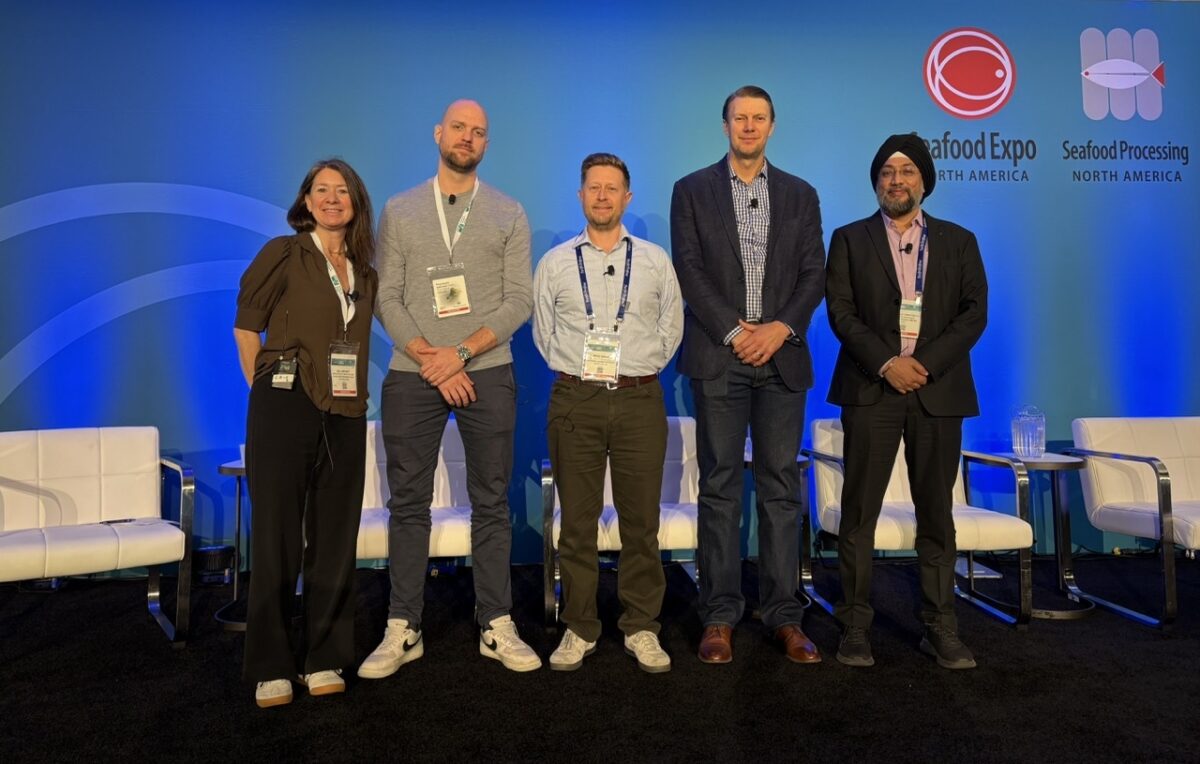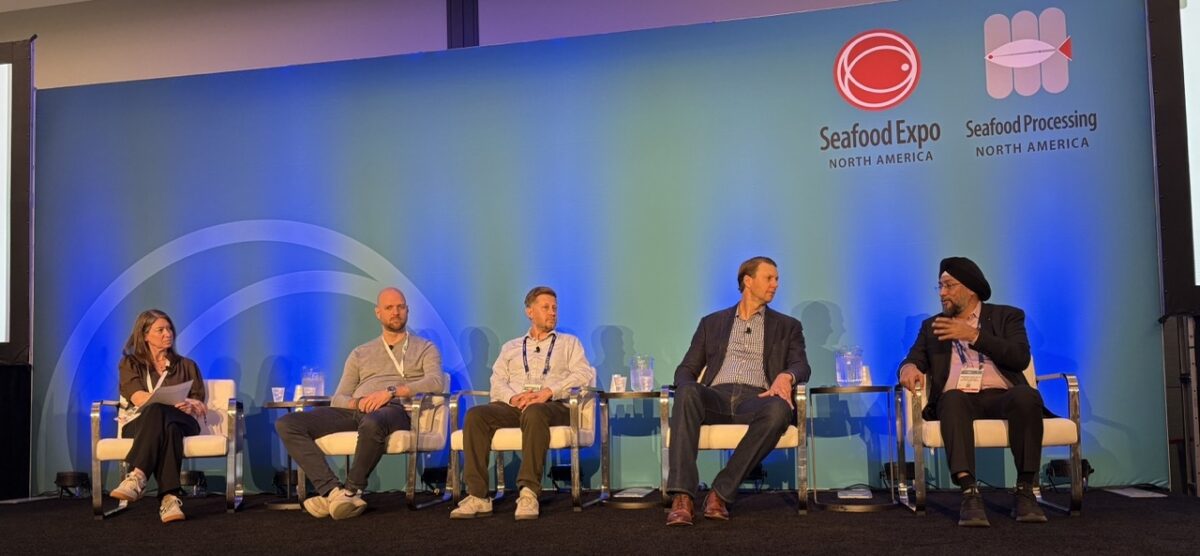
(L-R) Jill Swasey, Director of Impacts, ASC; Roy van Daatselaar, Global Lead Improver Programmes, ASC; Brad Spear, Outreach and Engagement Director, SFP; Blake Stok, Senior Director of Sustainability for Thai Union’s Global Frozen Business; Sarabpreet Singh, General Manager, Devi Seafoods
At a conference panel during Seafood Expo North America, participants discussed practical next steps for scaling-up landscape aquaculture, building on shared experiences of moving from farm-by-farm certification to area-wide transformation in Andra Pradesh, India. SFP and the Aquaculture Stewardship Council (ASC) have been collaborating for more than two years in the region, working with local stakeholders to understand shared challenges and opportunities and build a Roadmap for landscape-level improvements.
ASC Director of Impacts Jill Swasey moderated the panel, asking the participants to explore how to move from theory to implementation, in India and around the world.
A landscape approach to aquaculture can address shared risks that a farm-by-farm approach cannot, including water quality and disease prevention, the panelists said. “If a single farm is following practices and the neighboring farms are not falling in line,” individual farm certifications can have limited impact, said Sarabpreet Singh, General Manager of Devi Seafoods, the leading exporter of shrimp from India.
This approach provides benefits not just for the farmers and the local environment, but also for the entire supply chain. “The most compelling business case for landscape aquaculture is around security of supply,” Blake Stok, Senior Director of Sustainability for Thai Union’s Global Frozen Business, noted, “ensuring that you have a stable, consistent, predictable supply chain – not just now but into the future.”
Stok also highlighted the importance of pre-competitive collaboration to address shared risks, to protect everyone’s investments. “We might compete on quality and timeliness and price, but we don’t compete on water quality and disease management.”
Risks also come from outside of the shrimp farming sector, from other industries operating in the same landscape and watershed, Brad Spear, SFP Prospecting and Engagement Director said. He added that that that is why it is important for the shrimp industry to have a voice in discussions about development plans that affect the areas where they want to farm.
Roy van Daatselaar, head of ASC’s Improver Programme, said this is where NGOs like SFP and ASC can play an important role, supporting capacity building and empowering global stakeholders to “make sure that smaller farmers are included and part of the business of tomorrow.”
Working closely with local stakeholders on the ground is a key part of the landscape approach. In response to a question about where to start, Spear joked that “you ask somebody other than me.” But seriously, he added, local farmers and other organizations “have the insights and the long-term need of sustaining an industry in their communities and the environment around it. They need to have their voices be heard.”
Education and awareness raising is an important part of empowering those local stakeholders to support and participate in landscape aquaculture. Singh emphasized the role of knowledge exchange between different initiatives to share technical knowledge and build trust. Helping farmers form co-ops and work together can increase market access for them by reducing some of the fragmentation in the market and making engagement with buyers easier.
The need for education also extends in the other direction, up the supply chain to large buyers and retailers, to help them “understand the need and value for these initiatives and how they fit into their product mix,” Stok said. “The sustainable seafood movement has done an excellent job of helping companies build policies around purchasing of sustainable seafood, but those policies can also be very constricting and limited. We need to do a better job of educating industry about how these products are in line with their policies.”
The panelists all agreed that there is an important role for government in supporting landscape approaches, through regulation and enforcement, environmental management, and social oversight. Governments can create policies and programs to support small farmers. Word of mouth is also very important, Singh said. “If something is working, others will want to get involved. It’s a domino effect.”